As we mark World Environment Day 2025 under the global theme ‘Ending Plastic Pollution’, the Centre for Law and Transformative Change (CLTC) highlights the work of its partner, Munnade, a community-based organisation that has long championed labour rights of women garment workers. We must shift the spotlight to those who experience the worst consequences of environmental degradation yet are routinely excluded from policy spaces: women garment workers.
In the southern Indian state of Karnataka, particularly in Bengaluru, a major urban and industrial hub, women garment workers are concentrated in sprawling industrial zones such as Peenya Industrial Area, Bommanahalli, and Mysore Road. In these areas, women work in hazardous factories and live in overcrowded settlements surrounded by open drains, chemical effluents, toxic air, and heat-trapping tin homes. These environmental threats are not distant or future risks, they are a daily reality that undermines health, dignity, and basic safety.
In Peenya Industrial Area, for example, one woman wakes each morning to the stench of chemical waste leaking from nearby factories. Her shift in a poorly ventilated factory brings no relief only further exposure to pollutants, heat, and dust. She is one among thousands navigating overlapping environmental and workplace harms without protections.
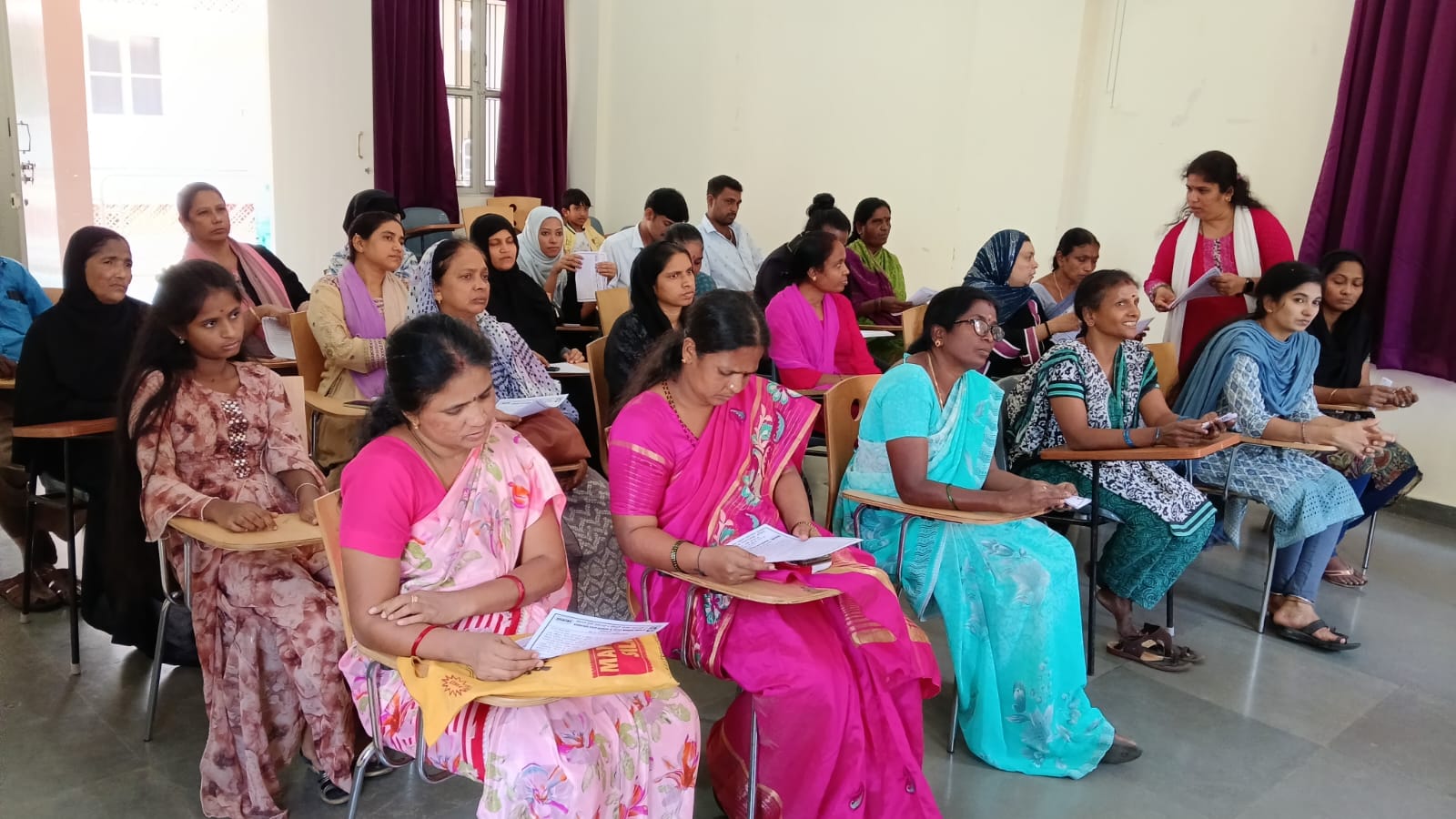
At Munnade, community organisers shared that they witness firsthand how environmental issues like plastic pollution deeply impact the daily lives of women garment workers. These are not distant or abstract problems. They affect the air we breathe, the water we drink, and the health of our families. Through our work, we have conducted health awareness sessions, organised community clean-up drives with workers and their children and promoted eco-friendly alternatives to single-use plastics. Most importantly, we’ve created spaces where women can safely share their experiences of how pollution seeps into their homes and workplaces, threatening their wellbeing and that of their children.
These issues are not accidental. They are the result of systemic neglect. Plastic-choked drains, chemical runoff, and air pollution in garment worker neighbourhoods are by-products of an economic model that treats both labour and the environment as expendable. Women from Dalit and OBC (Other Backward Communities) communities are especially affected, as they are pushed into insecure work and forced to live in degraded, flood-prone, and poorly serviced urban margins.
Historically, trade unions have rightly focused on wages, contracts, and safety inside the factory. But in Karnataka, a shift is underway. Garment worker unions and Labour Organisers such as Munnade are recognising that environmental degradation is inseparable from labour injustice. Access to safe water, clean air, and protection from extreme heat is no longer seen as separate from the right to fair work. They are part of the same fight. Social media and digital connectivity have allowed garment workers to connect with broader environmental justice movements, share strategies, and build solidarity across geographies. As one Munnade organiser noted, “When we fight for clean water or protection from heat, we’re still fighting for our right to work and live with dignity.”
The Government of Karnataka has a clear responsibility to embed the voices and concerns of these workers into environmental policy and urban planning. Yet, women garment workers remain largely excluded from environmental decision-making processes. Worse, those who speak out face intimidation or retaliation. Most garment workers are on temporary or informal contracts. Reporting workplace abuse, wage theft, or unsafe conditions often results in demotion, dismissal, or blacklisting. Without legal protection, including them in environmental monitoring or planning can further increase their vulnerability, especially when polluting employers wield local political or economic power.
The state must move from tokenistic consultation to institutionalised and legally protected participation. This includes giving garment worker representatives formal roles in ward-level planning and climate resilience programmes; involving labour unions in BBMP’s solid waste, sanitation, and pollution control efforts; co-developing environmental risk maps with communities living near factory zones; and explicitly incorporating worker-related risks into the Karnataka State Action Plan on Climate Change. The BBMP Climate Action and Resilience Plan (BCAP) offers a promising framework, but it must be grounded in the everyday realities of those most exposed to environmental harm not just designed by experts or private actors.
India’s constitutional framework and legal architecture provide a strong foundation for environmental justice. Article 21 guarantees the right to life, which has been interpreted by the Supreme Court to include the right to a clean and healthy environment. Articles 48A and 51A(g) reinforce this by assigning environmental responsibility to both the state and citizens. The Environment (Protection) Act, 1986, Factories Act, 1948, and National Green Tribunal Act, 2010 offer mechanisms to enforce these rights, while India’s ratification of key ILO conventions recognises the importance of occupational health and environmental safety. However, these rights are only meaningful if they are enforceable, accessible, and protected from retaliation especially for informal workers, women, and those already living on the margins.
The recent floods in Bengaluru laid bare the city’s environmental injustice. Images of submerged homes, broken infrastructure, and women wading through chest-deep water with children in tow shocked the public. But for garment workers in flood-prone neighbourhoods, this is not an exception. It is a recurring reality. When heatwaves hit, they are the first to collapse in overheated factories. When the drains overflow, it is their homes that drown. When waste piles up, it is their children who fall sick. The environmental crisis is not on the horizon. It is here, and its heaviest burden falls on those who contribute least to its causes.
As Miriam Chinnappa, Executive Director of the Centre for Law and Transformative Change, observes: “This World Environment Day highlights the urgent need to reassert environmental justice as a working-class, feminist, and social justice struggle. It is time to expand our understanding of labour rights to include the fundamental right to live and work in safe, healthy environments. Building a truly inclusive environmental agenda means bringing together trade unions, women’s organisations, civil society, and public institutions and recognising the leadership of working-class women, who are already at the frontlines of this crisis and carry the wisdom to lead transformative change.”
Environmental justice cannot be achieved through policy frameworks alone. It must be grounded in equity, meaningful participation, and strong protections. On this World Environment Day, as the global community pledges to end plastic pollution and protect ecosystems, we must also commit to centering those most affected by environmental harm. Women garment workers are not passive recipients. They bring lived knowledge and grounded solutions that can inform more inclusive and just environmental action. Ensuring their voices shape environmental governance is not just a matter of fairness. It is essential to building an equitable and sustainable environment for all. It is time to create space for their leadership, now not tomorrow.